Your Music Is Great. Your Bio Is Why Nobody's Heard It.
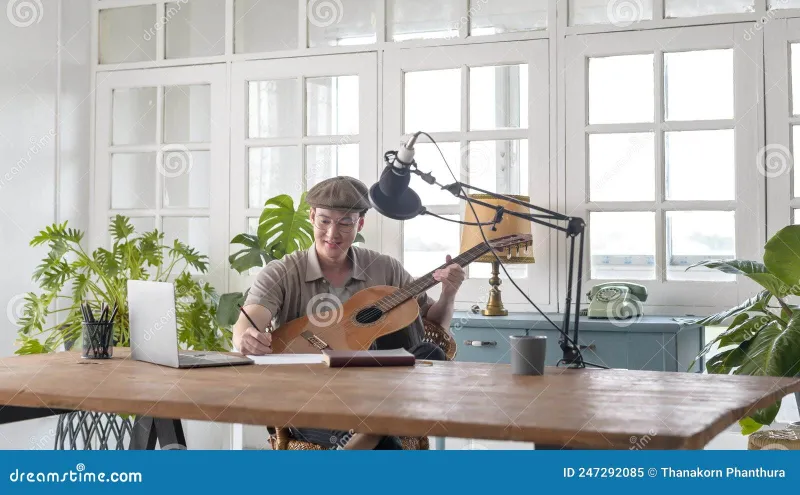
Photo: musician writing laptop home studio notebook, via thumbs.dreamstime.com
There's a moment in every A&R inbox, every playlist curator's DMs, every music blog's submission folder where a decision gets made in about four seconds. It's not made on the song — not yet. It's made on the two sentences sitting above the streaming link. And for a huge share of emerging artists, those two sentences are doing active damage.
The Bio Is Not About You. It's About the Reader.
Here's the cognitive mismatch: artists write bios as self-portraits. Gatekeepers read them as risk assessments. A curator deciding whether to add a track to a playlist isn't asking "who is this person?" They're asking "if I vouch for this, will I look smart or sloppy?"
A bio that answers the risk question does three things fast: it locates you in a scene or sound people already understand, it gives one concrete proof point, and it gets out of the way. Everything else is friction.
What a Bad Bio Actually Sounds Like
We pulled anonymized examples from real artist profiles (details changed, patterns preserved). Here's a typical offender:
"Music has always been my passion since I was a little kid. I pour my heart and soul into every song. My sound is a unique blend of genres that can't be described. Check out my new single out now on all platforms!"
Every line is a red flag. "Passion since childhood" tells the reader nothing. "Unique blend that can't be described" actively tells curators you don't know your own lane — and if you don't, they certainly won't figure it out for you. "Out now on all platforms" is a command without a reason.
The Rewrite, Line by Line
Same artist, rebuilt:
"Hailing from Tucson's desert-punk scene, Mara Vex pairs surf-guitar grit with lyrics about growing up between two languages. Her last single earned spins on three regional college stations and a sync in an indie film short. New single 'Saltillo' is for fans of Soccer Mommy and early Yeah Yeah Yeahs."
Notice what changed. There's a place (Tucson), a scene (desert-punk), a specific sonic description (surf-guitar, bilingual lyrics), two verifiable proof points (college radio, a sync), and two reference artists that let a curator file her instantly. Same person. Same music. Completely different risk profile.
The Three-Sentence Formula
If you're starting from scratch, this structure covers 90% of what gatekeepers need:
- The locator: City, scene, and sound in one breath. "Brooklyn-based bedroom pop with jazz chords and a dry sense of humor."
- The receipt: One real, checkable fact. A station that played you, a festival slot, a notable open, a playlist add, a number that isn't purchased.
- The shelf: Two comparable artists. This feels cringe to write and works every single time, because it translates your sound into the reader's existing mental filing system.
Where the Bio Lives Matters Too
Artists obsess over the Spotify canvas and ignore the Spotify bio. Curators check streaming profiles, Bandcamp pages, and Linktree stacks before they check anything else. If your bio says "can't be described" on Spotify but your Bandcamp page has a sharp, specific story, you're inconsistent — and inconsistency reads as amateur. Write one strong paragraph and version it everywhere: streaming profiles, press kit, EPK page, social accounts.
The Uncomfortable Truth
Nobody wants to admit that a paragraph of prose can gatekeep music. But the discovery pipeline is human at the choke points — a curator, a radio programmer, a blog editor — and humans read words before they hear songs. Your bio is the first track anyone plays. Make it a good one.
Write it like you're telling one specific person — the tired curator at midnight, scrolling — exactly why they can trust you. Then stop writing.