Hit Records, Humble Setups: How Today's Chart-Toppers Are Being Made in Living Rooms and Closets
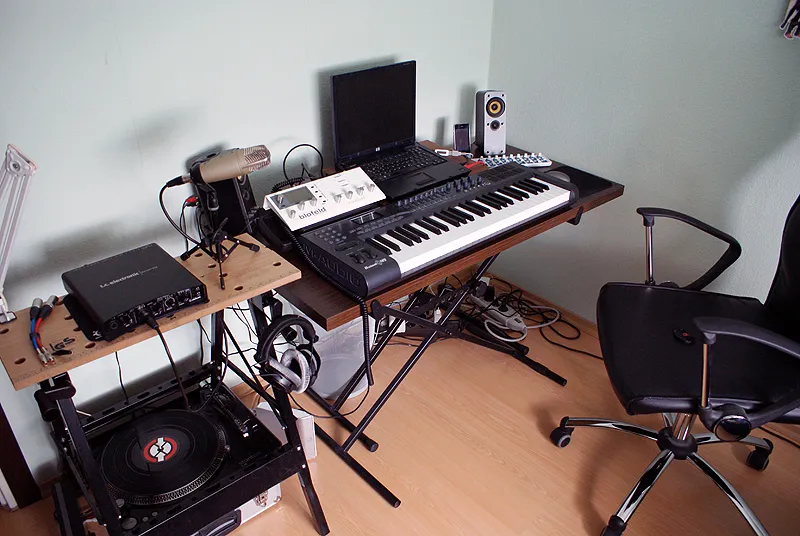
Photo: LiquidMolly, CC BY-SA 2.0, via Wikimedia Commons
Picture a recording studio. Chances are you're imagining something out of a classic rock documentary — a massive mixing board, a glass-walled vocal booth, a team of engineers in expensive chairs. Maybe a leather couch and a bowl of M&Ms with the brown ones picked out.
Now picture where a significant chunk of 2024's biggest songs were actually made: a converted closet in a Brooklyn apartment. A spare bedroom in Atlanta with moving blankets staple-gunned to the walls. A laptop propped on a nightstand at 2 a.m. because the idea wouldn't wait until morning.
The gap between those two images tells you everything you need to know about where the music industry is right now.
The Democratization Nobody Saw Coming (Or Did They?)
The shift toward home production isn't new — it's been building since the early 2000s when software like GarageBand and FL Studio started putting professional-grade tools in the hands of anyone with a laptop. But something accelerated during the pandemic years that has fundamentally changed the math on what it costs to make a commercially viable record.
Equipment that would have run a producer $20,000 in 2005 can now be replicated for under $1,000 — and in many cases, for free. The plugins that once required a major label's budget are now available as free VSTs (virtual studio technology instruments) on sites like Plugin Boutique and KVR Audio. Digital audio workstations like Reaper offer near-professional functionality for a one-time payment of $60. Even the gold-standard DAW Logic Pro X is $199 — a one-time purchase, not a subscription.
For a generation of producers who grew up watching YouTube tutorials instead of attending audio engineering school, this is the only world they've ever known.
What a Modern Home Studio Actually Looks Like
Let's get specific, because the "home studio" concept covers a lot of ground — from a teenager with earbuds and a free Audacity download to a seasoned producer with a professionally treated room and a $3,000 microphone.
For most of the breakout producers making waves right now, the setup lands somewhere in the middle. A typical starter kit that can genuinely produce release-quality music looks something like this:
- DAW: FL Studio, Ableton Live, or Logic Pro X (Mac users)
- Audio interface: Focusrite Scarlett Solo or 2i2 ($120–$180)
- Studio monitors or headphones: Audio-Technica ATH-M50x or KRK Rokit 5s ($150–$200)
- Condenser microphone: Audio-Technica AT2020 or Blue Yeti ($100–$130)
- MIDI keyboard: Arturia MiniLab or Akai MPK Mini ($60–$100)
All in, you're looking at roughly $600–$700 to put together a rig that can produce, record, and mix professional-sounding tracks. That's less than one hour of time at a mid-tier commercial studio in Los Angeles.
The Producers Proving It Works
Take the story of producers like Taz Taylor, co-founder of Internet Money, who built a production empire largely from home setups before his beats started landing on platinum records. Or look at the trajectory of producers like Malay Ho, who worked on Frank Ocean's channel ORANGE using a setup that would raise eyebrows at most major studios for how stripped-down it was.
More recently, the production behind breakout R&B and rap records has consistently surprised industry veterans when they learn the technical origin stories. Tracks that sound polished and radio-ready are being mixed on consumer headphones because the producer has trained their ears to compensate. Vocal takes are being recorded in closets packed with clothes to dampen reverb — a trick that genuinely works, by the way, because fabric absorbs sound frequencies that would otherwise bounce off hard walls.
"The room is the most important piece of equipment you own," says one independent producer based in Houston who asked to be identified only as Drvmr. "But you don't need a perfect room. You just need to understand the room you're in."
Software That's Leveling the Playing Field
Beyond the hardware, the software landscape in 2024 has become almost absurdly generous for aspiring producers. Here are some tools that are genuinely free and genuinely powerful:
LMMS (Linux MultiMedia Studio): A full-featured DAW that runs on Windows, Mac, and Linux. It's not as intuitive as Ableton, but it's capable of professional output in the right hands.
Vital: A spectral warping wavetable synthesizer that competes directly with $200+ paid synths. The free version is legitimately excellent.
GarageBand: Still criminally underrated. Several Grammy-winning tracks have been started or finished in GarageBand, and it comes pre-installed on every Mac and iPhone.
Splice Sounds (free tier): While the full library requires a subscription, Splice offers a rotating selection of free samples that can seed a whole production.
OBS + a good microphone: Increasingly, producers are using streaming software not just to broadcast but to record high-quality audio sessions that would otherwise require dedicated recording software.
The Unconventional Spaces Making Hits
Beyond the gear, the locations where music gets made have gotten genuinely creative. Bathroom acoustics — naturally reverberant and often sonically interesting — have become a go-to for certain vocal styles. Several well-known indie and alternative artists have deliberately kept bathroom recordings in their final mixes because the sound was exactly right.
Cars are another surprisingly common recording environment. The upholstered interior of a vehicle creates natural sound absorption, and the intimacy of the space tends to loosen up vocalists who might feel stiff in a formal booth. It sounds like a workaround. Sometimes it becomes the aesthetic.
One producer in Chicago described recording an entire EP's worth of ambient textures by placing a microphone outside his apartment window during a thunderstorm, then layering those recordings under synthesizer tracks. The resulting album — made almost entirely in a 400-square-foot studio apartment — landed on multiple year-end lists.
What Aspiring Producers Actually Need to Hear
If there's one thing that separates the bedroom producers who break through from those who don't, it isn't equipment. It's output volume and willingness to share work before it feels ready.
The producers who are landing placements and building audiences in 2024 are the ones releasing music consistently — not waiting for the perfect mix or the perfect sample clearance or the perfect moment. Platforms like SoundCloud, YouTube, and TikTok have created direct feedback loops between producers and audiences that simply didn't exist fifteen years ago.
The other factor is community. Online producer forums, Discord servers, and beat-selling platforms like BeatStars have created ecosystems where emerging producers can get their work in front of artists, other producers, and occasionally A&R reps who are actively scouting outside traditional channels.
The expensive studio still has its place — for final mixing, for mastering, for recording live instruments with precision. But the idea that you need institutional access to make something real? That ship has sailed. The next big record might be finishing its mix right now, somewhere in a closet with the lights off and a pair of headphones that cost less than dinner for two.